



What is the difference between MMM and MTA?
Marketing mix modelling (MMM) is a statistical method that estimates what each channel contributed to the business from aggregate historical data, total spend against total sales. Multi-touch attribution (MTA) is a measurement method that tracks individual customer journeys and shares conversion credit across the touchpoints in them. MMM covers everything including offline. MTA covers what is trackable, in detail, quickly.
Neither one wins. They answer different questions at different altitudes, and each is blind exactly where the other sees clearly. MMM will tell you that television moved the business last quarter but not which television spot to buy next week. MTA will tell you which Meta creative sat in the journeys that converted but has no idea the television campaign was running at all.
The practical question is therefore not which method is correct. It is which question you are being asked to answer, and whether the method you have can answer it.
What is marketing mix modelling?
Marketing mix modelling is a statistical technique that uses historical aggregate data to estimate the revenue contribution of each marketing channel. It takes total spend, impressions, sales volume, price, promotion, seasonality and external market conditions, then uses regression to separate how much of the business outcome each input caused.
The word “caused” is doing real work in that sentence. MMM does not observe journeys and infer credit from them. It observes variation: weeks where you spent more on radio, weeks where you spent less, weeks where a competitor was heavy, weeks where the weather was wrong. It then estimates how much of the movement in sales each of those inputs explains. That is a genuinely different logical claim from attribution, which reports what was present before a conversion.
MMM was built for television, radio and print, in an era when tracking an individual was impossible. That heritage is why it holds up now: no cookies, no device IDs, no consent to user-level collection. It measures what happened, not who did it.
What MMM genuinely does better
- Offline channels, on equal terms with digital. Television, radio, out-of-home, print, sponsorship and physical events all enter the model as inputs alongside paid search. Nothing about them is second-class in an MMM.
- No cookie dependency at all. Not “cookieless with caveats”. MMM never needed user-level data, so nothing about browser policy or consent rates degrades it.
- A longer horizon. MMM can estimate carryover and adstock, so brand spend that pays back over months is visible rather than written off. It also estimates price elasticity, which no attribution model touches.
- Halo between channels. A television burst that lifts branded search click-through shows up in MMM as a cross-effect. In attribution it shows up as good search performance.
- Base versus incremental. MMM estimates the business you would have had with zero advertising. That baseline is often the single most uncomfortable and most useful number in the model, and it is the one attribution cannot produce.
- External factors. Seasonality, competitor activity, distribution changes and macro conditions are modelled explicitly rather than treated as noise.
What MMM genuinely costs you
It needs years of history before it can run. MMM learns from variation over time, which means it needs enough time. The requirement is two to three years of consistent weekly data covering spend, sales, price and promotion. If you launched eighteen months ago, changed your channel mix twice, or rebuilt your tracking last spring, you may simply not have a modellable history yet.
It needs variation, not just volume. If you have spent the same amount on the same channels every week for two years, the model has almost nothing to learn from. Flat spend produces wide confidence intervals and unstable coefficients. This is the constraint teams are least prepared for, because it punishes exactly the disciplined, steady media plans that look best on paper.
Feedback is slow relative to campaign decisions. Model refreshes run weekly, monthly or quarterly. Two things are worth separating here, because they get conflated and the conflation makes MMM sound slower than it is. The years of history are what the model is built from: without them there is nothing to model, and no software shortens that. Running the model is a different matter. Once the history is integrated, modern MMM software builds fast: exploratory models can be live within a couple of hours of initial data integration, and scenarios can be re-run in an afternoon rather than waiting on a consulting cycle. So the honest statement is that MMM needs years of data and hours of modelling, not years of waiting. What does not compress is the decision cadence. No refresh frequency turns a quarterly allocation model into something that tells you what to pause this afternoon.
It is aggregate only, so it cannot optimise a campaign. This is the hard ceiling and it is structural, not a maturity problem. MMM works on channel-week totals. It has no ad group, no creative, no audience, no keyword. It can tell you paid social earned more budget. It cannot tell you which of your forty paid social campaigns deserves it.
Results come with uncertainty attached. An MMM output is an estimate with a confidence interval, and honest practitioners show it. That is scientifically correct and politically awkward, because a range is harder to put in a board deck than a single number.
What is multi-touch attribution?
Multi-touch attribution assigns conversion credit across the touchpoints a customer engaged with before converting. Where MMM works on channel totals, MTA works on the individual journey: which search ads, display impressions, emails and social posts each person encountered, and how credit should be divided between them. A fuller treatment sits in what multi-touch attribution is and how it works.
Models range from rule-based (first-touch, last-touch, linear, time decay) to data-driven approaches that derive the weighting from patterns in your own conversion data, each of which is worked through in the guide to multi-touch attribution models. The choice of model matters less than most comparisons suggest. What matters more is whether the touchpoints were captured at all and whether they were correctly joined into one person’s journey. A sophisticated model on incomplete journeys produces confident nonsense.
What MTA genuinely does better
- Granularity that can be acted on. Keyword, creative, audience, placement, device. This is the level at which a performance manager actually works.
- Speed. Once data sources are connected, MTA updates daily. A creative launched Monday can be judged by Thursday.
- Sequence and timing. Whether retargeting works better at two exposures or five, and how long after first exposure conversions land, are questions only journey-level data answers.
- Interaction inside the digital stack. Whether paid social re-engages visitors who first arrived through organic search, for example.
- Impressions, where the tooling captures them. Attribution that includes ad views and not only clicks can value demand creation rather than only demand capture. See upper-funnel tracking for how that changes the numbers. Orange saw this directly: once impressions entered the model, channels that had looked marginal turned out to be starting the journeys other channels closed, and revenue doubled.
Where MTA genuinely falls short
Offline leaves no signal. Television, radio, out-of-home and physical events produce no touchpoint to attribute. MTA does not undervalue these channels, it cannot see them, which is worse: they are absent from the denominator entirely.
No macro view. MTA does not model seasonality, price, competitor pressure or economic conditions. It describes how converting journeys were composed, not what moved total demand.
Incomplete journeys. MTA is only as good as the journeys it can reconstruct. Walled gardens do not export impression-level data, third-party cookies are largely gone, consent is refused, and cross-device paths break. Depending on market and setup, some businesses might miss up to 50% of their data. Everything the model concludes afterwards is drawn from what survived. Roivenue client data shows over 50% of revenue is misattributed under last-click models, which is the same problem seen from the other end.
It describes, it does not prove. Attribution reports co-occurrence: this touchpoint was present in journeys that converted. It cannot tell you what would have happened without the ad. That is an incrementality question, and it needs either holdout testing or a model built on causal logic, which is precisely what MMM is.
MMM vs MTA: side by side
| Dimension | Marketing mix modelling (MMM) | Multi-touch attribution (MTA) |
|---|---|---|
| Question it answers | How much did each channel contribute to total business outcomes, including offline and base demand? | Which touchpoints appeared in the journeys that converted, and how should credit be shared? |
| Unit of analysis | Aggregate channel, macro and market data | Individual user-level journeys |
| Data required | Years of consistent history: spend, sales, price, promotion, external factors | User-level event and identity data |
| Cookie dependency | None. Inherently privacy-safe by design | Depends on the platform. Cookieless implementations exist |
| Offline channels | Full coverage | No coverage |
| Digital channels | Portfolio-level view | Granular campaign-level view |
| Update frequency | Weekly, monthly or quarterly | Daily or near real time |
| Time to first insight | Hours for an exploratory model once the history is integrated, but only if two to three years of history exists to integrate | Days once data sources are connected |
| Can it optimise a live campaign? | No. Aggregate data has no creative, keyword or audience in it | Yes. This is its main operational purpose |
| Causal claim | Estimates incremental contribution from variation over time | Describes co-occurrence in observed journeys, not incrementality |
| Long-term and brand effects | Yes, through carryover and price elasticity | Poorly. Effects outside the lookback window are lost |
| Primary use case | Strategic budget allocation across the portfolio | Campaign, creative and bid optimisation |
| Primary audience | CMO, CFO, planning and strategy | Performance marketers and campaign managers, plus the CMO |
| Privacy position | Inherently compliant, no user-level data | Compliant where built on first-party data without cross-site identifiers |
| Output form | Estimates with confidence intervals | Attributed revenue per touchpoint, presented as point values |
The two rows most worth arguing about are “causal claim” and “can it optimise a live campaign”. They explain why teams that own one method keep reaching for the other. Attribution is actionable but descriptive. MMM is causal but not actionable. Anyone telling you their single method covers both is selling.
When should you use marketing mix modelling?
MMM is the right approach when:
- Significant spend sits in offline channels that leave no digital signal.
- You need long-term brand effects and price elasticity, not just conversions inside a lookback window.
- Your sales cycle runs across months, so journey-level tracking is truncated or misleading.
- Privacy regulation or your own data governance limits the user-level data you can hold.
- You need the base volume: the business that would exist with zero advertising.
- The question is genuinely about incrementality rather than credit, and you need a method whose logic is causal rather than observational.
MMM is the wrong tool for in-flight optimisation, creative testing and bid decisions. It is also the wrong tool if you do not yet have the history, and no amount of software maturity fixes that. If you have twelve months of data and a channel mix that changed twice inside it, MMM will produce a model. It will not produce a model anyone should reallocate against.
When should you use multi-touch attribution?
MTA is the right choice when:
- You need day-to-day feedback at keyword, creative or audience level.
- You are reallocating faster than a quarterly planning cycle allows.
- You need to understand sequence, timing and interaction across the digital journey.
- You want impression-level visibility into upper-funnel and walled garden activity alongside clicks.
- You need measurement that does not depend on third-party cookies. How that works in practice is covered in cookieless measurement.
MTA becomes insufficient the moment meaningful spend moves into channels with no digital footprint, or the moment the question shifts from “which campaign” to “how much should this channel get in total”. UPC Slovakia cut marketing spend by 34% without losing revenue, which is the kind of decision journey-level data supports well: it was a reallocation inside trackable media, not a judgement about total brand investment.
Can you use MMM and MTA together?
Yes, and for most advertisers above a certain size it is the correct answer rather than a compromise. The two methods are used at different altitudes: MMM sets the envelope for each channel across a planning cycle, MTA allocates inside the envelope week to week and reports back what happened.
That division of labour only works if one thing is true: the MTA layer has to be complete enough to be worth trusting inside the envelope. If half the journeys are missing, MTA is not optimising within the plan, it is guessing within it. Which is why the unglamorous work, connecting the platforms, capturing impressions rather than only clicks, and joining journeys across devices without third-party cookies, matters more than the model choice. Roivenue connects 70+ platforms for exactly this reason: to include spend, impressions and platform-side data that no UTM parameter carries.
Experiments are the third leg. A geo test or a holdout answers the incrementality question directly rather than inferring it, and it gives both other methods something to be checked against.
What do you do when MMM and MTA disagree?
They will disagree, and the disagreement is information rather than a failure. It usually takes one of four shapes, and each has a different fix.
MTA credits a channel that MMM says did little. Most often this is a demand-capture channel taking credit for demand something else created. Branded search is the classic case: it converts beautifully and creates almost nothing. MMM sees the total and is unimpressed. Trust MMM on the total; use MTA to keep managing the channel efficiently.
MMM credits a channel MTA barely registers. Usually upper-funnel or offline activity that leaves no trackable touchpoint. Check whether the gap is real or a coverage artefact: if your attribution records clicks only, an impression-heavy channel will always look weak in it.
Both agree on direction and disagree on size. This is the healthy case and generally needs no resolution. Use MMM’s number for the budget envelope and MTA’s for relative ranking inside the channel.
They contradict each other on a channel you are about to cut. Do not resolve it with a meeting. Run an experiment. A holdout or geo test on that one channel is cheaper than either being wrong, and it produces the only evidence that survives a challenge from finance.
What is unified marketing measurement, and when do you need it?
Unified marketing measurement (UMM) is a measurement framework that combines multi-touch attribution, marketing mix modelling and incrementality experiments into one calibrated view, so that each method is checked against the others rather than trusted on its own.
The three legs do different work. MTA supplies the granular digital signal: which creative, which keyword, which audience, refreshed daily. MMM supplies the portfolio view: offline channels, base demand, price elasticity, and effects that pay back over months rather than inside a lookback window. Experiments supply the one thing neither of the others can produce, a causal answer, because a geo test or a holdout creates the comparison instead of inferring it from what already happened.
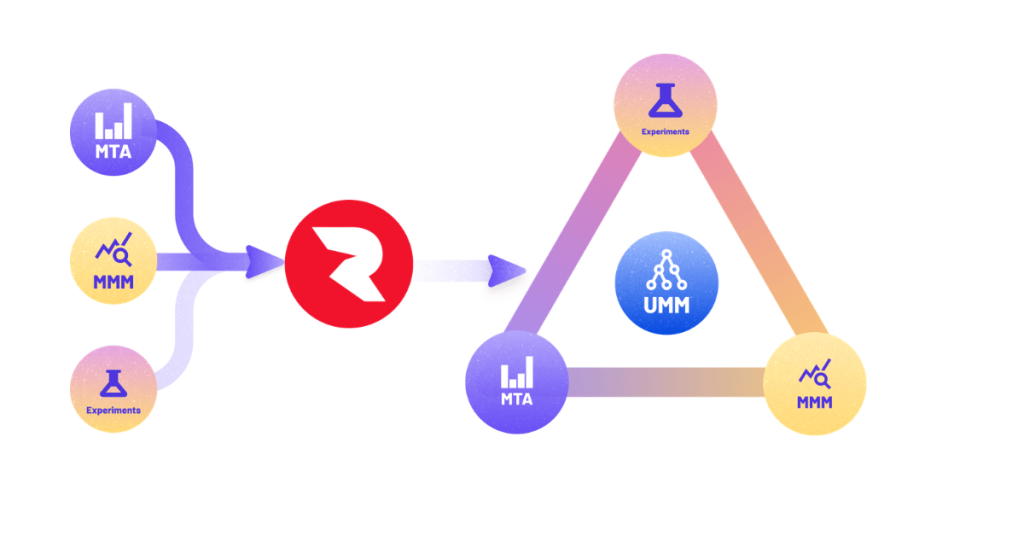
Calibration is what separates this from owning three tools. The practical version is narrow enough to write down: MMM governs how large each channel’s budget should be, MTA governs allocation inside that budget, and an experiment settles the cases where the two disagree on a decision that matters. Each method is used where its logic is strongest and discounted where it is weakest. The four disagreement patterns above stop being arguments in a meeting and become a rule about which method governs which decision.
When you actually need it
Two of these three conditions is usually the threshold:
- Meaningful spend sits outside trackable media. If television, radio, out-of-home or sponsorship carry real budget, attribution cannot see them at all, and a portfolio decision made on attribution alone is made on a partial denominator.
- The allocation question and the optimisation question are both live. Someone is asking how much a channel should get in total while someone else is asking which campaign inside it to fund. Those are different altitudes and one method will not serve both honestly.
- A budget decision has to survive a challenge from finance. A number that can be defended by construction, with a stated method and a rule for handling conflict, holds up where a single figure from a single tool does not.
When you do not
Most teams should not start here. If your attribution layer is missing half its journeys, adding marketing mix modelling on top does not fix that. It gives you a second view of an incomplete picture, plus a reconciliation problem you did not have before. A single well-instrumented attribution layer beats a partial unified framework, and it is a much cheaper place to be.
The order that works is to make the digital layer complete, prove it against something, then add the portfolio view when an offline or long-horizon question forces the issue. Roivenue provides the attribution layer and the unified marketing measurement view built on top of it. The econometric modelling side comes from ScanmarQED, covered below.
What should you evaluate when choosing?
The comparison that matters is not feature lists. For MMM, ask:
- What history do we actually have, consistently, at weekly granularity, including price and promotion? Answer this before talking to any vendor.
- Does our spend vary enough for the model to learn anything, and if not, are we willing to introduce variation deliberately?
- What is the refresh cadence, and does it match our planning cycle rather than our reporting cycle?
- Are confidence intervals shown? A model presented as point estimates only is hiding its uncertainty.
For MTA, ask:
- What share of touchpoints does it capture on our own traffic? Measured, not claimed. This is the ceiling on everything else.
- Impressions or clicks only? Click-only tools structurally cannot value upper-funnel media.
- How is identity resolved across devices, and what happens to journeys it cannot resolve? Are they dropped, or quietly assigned to the last known touchpoint?
- Can the method be explained? If the weighting cannot be defended to a CFO, it will not survive the first budget challenge. What that looks like from the top of the org is covered on the CMO measurement page.
- Does the vendor sell media? A model built by a company that also sells inventory has an incentive you do not share.
Does Roivenue do marketing mix modelling?
No. Roivenue is a multi-touch attribution and unified measurement platform. It does not build econometric marketing mix models. MMM needs different data, a different modelling methodology and usually a different engagement shape.
For MMM, ScanmarQED, Roivenue’s parent company, provides dedicated econometric modelling as both software and consulting. ScanmarQED MMM outputs can be brought into Roivenue alongside the attribution layer, which is how the two ends of the spectrum meet in practice: strategic portfolio modelling on one side, campaign-level attribution on the other.
Where Roivenue puts its effort is the part that determines whether attribution is worth trusting at all: capturing impressions as well as clicks, reconstructing journeys with a mix of deterministic and probabilistic methods that work without third-party cookies, and keeping the model transparent enough to audit. Roivenue is ISO 27001 certified and does not depend on third-party cookies or persistent cross-site identifiers. Reporting and raw output can be taken out of the platform for your own modelling through data reporting and exports.
Frequently asked questions
Marketing mix modelling uses statistical analysis of aggregate historical data (total spend, sales, price, market conditions) to estimate each channel’s contribution to revenue at portfolio level. Multi-touch attribution assigns conversion credit to individual digital touchpoints in a user’s journey.
MMM is privacy-safe and covers offline channels but cannot optimise a campaign. MTA is granular and fast but sees only what is trackable. They answer different questions.
No. They operate at different altitudes and time scales. MMM gives a strategic, portfolio-level view suited to budget allocation. MTA gives a daily operational view suited to campaign optimisation.
A team that replaces MTA with MMM loses the ability to act inside a channel. A team that replaces MMM with MTA loses offline, brand and base demand.
Two to three years of consistent weekly data covering spend, sales, price and promotion, and enough variation inside it. The harder requirement is the second one: spend has to have moved enough for the model to learn from. Flat, unchanging budgets produce unstable results regardless of how many years you supply.
Note that the years apply to building the model, not to waiting for it. Once that history is integrated, exploratory models can be running within a couple of hours.
Yes. Modern implementations collect first-party data from your own site, combine it with ad platform data, and reconstruct journeys including impressions rather than clicks alone. Roivenue’s measurement is fully cookieless and GDPR and CCPA compliant, and does not rely on persistent cross-site identifiers.
Coverage still varies by market and consent rate, so ask any vendor for measured coverage on your own traffic.
A framework that combines multi-touch attribution, marketing mix modelling and incrementality experiments into one calibrated view. MTA supplies granular digital signal, MMM supplies the portfolio view including offline and long-term effects, and experiments supply causal ground truth to check both against.
It is a destination rather than a starting point: most teams get more value from making one method complete first.
No. Roivenue is an MTA and unified measurement platform and does not build or deliver marketing mix models. For MMM, ScanmarQED, Roivenue’s parent company, provides dedicated econometric modelling in software and consulting form.
Together the two cover the spectrum from strategic portfolio modelling to granular campaign attribution.
MTA is typically producing output within days of connecting data sources, and updates continuously after that. MMM depends far more on data readiness than on the modelling itself: if two to three years of clean weekly history exists, an exploratory model can be live within a couple of hours of initial data integration, and if it does not exist, no vendor can shortcut it.
Assume the history audit is the long pole, not the modelling.
Use MMM when your mix includes significant offline spend, when you need long-term brand and price elasticity effects, or when you need to model seasonality, competitor activity and base demand. Use MTA when you need day-to-day feedback on digital campaigns and want to move bids, creatives and audiences on a weekly basis.
Use both when you need the budget envelope and the allocation inside it, and use an experiment whenever the two disagree on a decision that actually matters.
The same method. "Marketing mix modelling" is the original econometric term and the broader one, covering price, promotion and distribution alongside media. "Media mix modeling" is the more common usage in digital marketing, where the model is usually restricted to media spend.
Spelling varies by region: "modelling" in British usage, "modeling" in American. None of these indicate a different technique.